
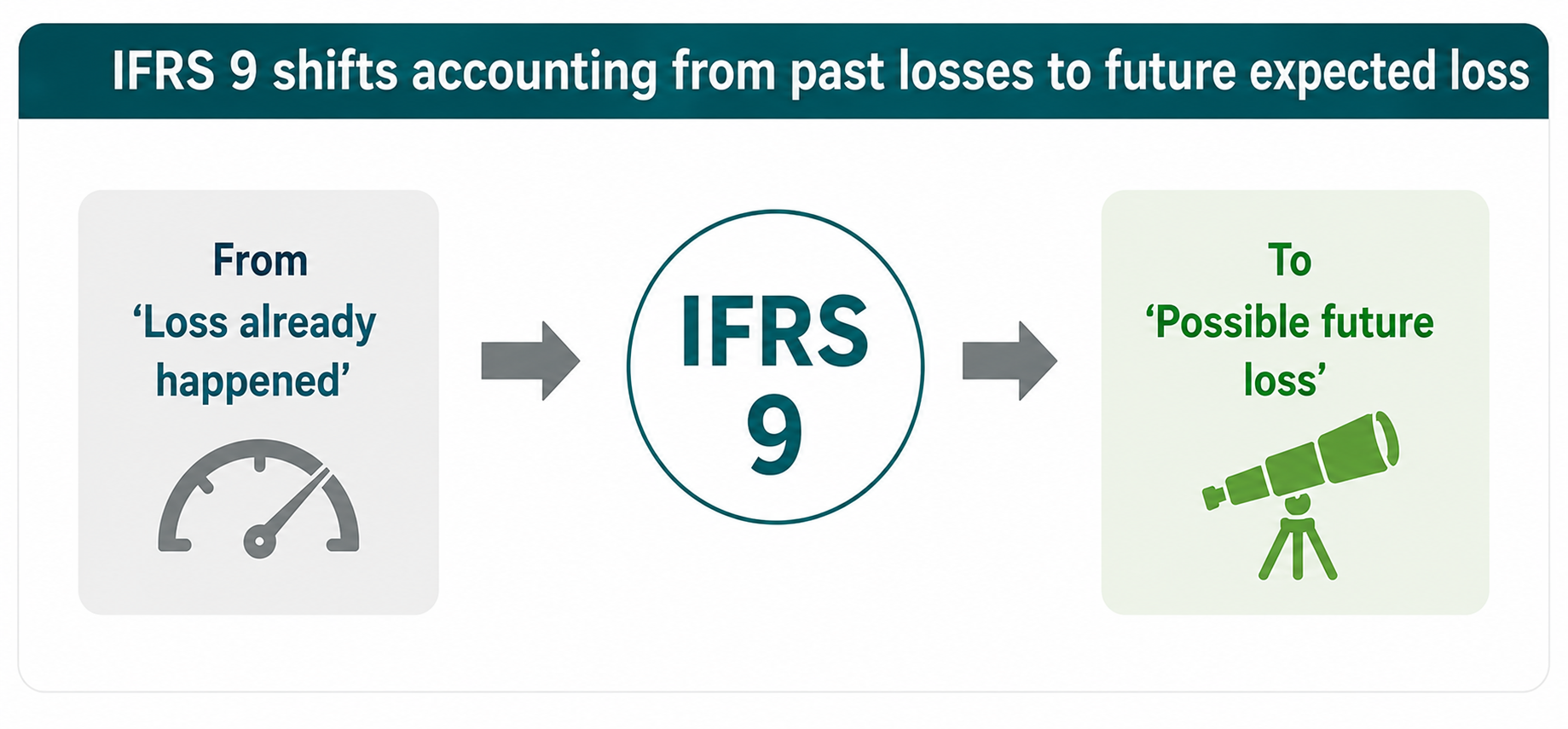
One of the most significant transformations introduced by IFRS 9 is the replacement of the traditional incurred loss model with a forward-looking Expected Credit Loss (ECL) model. Under previous practices, impairment losses were recognized only after objective evidence of loss had occurred. IFRS 9 fundamentally changed this approach by requiring entities—particularly banks and financial institutions—to recognize expected future credit losses at an earlier stage, even before actual default occurs. This shift enables proactive risk identification and enhances the reliability of financial reporting.
One of the most significant
transformations introduced by IFRS 9 is the replacement of the traditional incurred
loss model with a forward-looking Expected Credit Loss (ECL) model.
Under previous practices, impairment losses were recognized only after
objective evidence of loss had occurred. IFRS 9 fundamentally changed this
approach by requiring entities—particularly banks and financial institutions—to
recognize expected future credit losses at an earlier stage, even before
actual default occurs. This shift enables proactive risk identification and
enhances the reliability of financial reporting.

IFRS 9 is built around three principal areas:
1.
Classification and Measurement of
Financial Assets
Financial assets are classified based on:
- Business
Model Test: How an entity manages financial assets (hold to collect,
hold to collect and sell, or trading).
- SPPI
Test (Solely Payments of Principal and Interest): Whether contractual
cash flows represent only repayment of principal and interest.
Based on these assessments, financial assets are measured
under one of the following categories:
- Amortized
Cost
- Fair
Value Through Other Comprehensive Income (FVOCI)
- Fair
Value Through Profit or Loss (FVTPL)
The classification directly influences profit recognition,
valuation methods, and risk exposure.

2. Impairment through Expected Credit Loss (ECL)
The ECL model requires estimation of future credit losses
using both historical data and forward-looking economic information. Expected
losses are generally determined considering:
- Probability
of Default (PD)
- Loss
Given Default (LGD)
- Exposure
at Default (EAD)
- Macroeconomic
assumptions
- Industry
and borrower-specific risks
The ECL model operates under a three-stage impairment
framework:
|
Stage |
Credit
Condition |
Provision
Requirement |
|
Stage 1 |
Performing
asset |
12-month ECL |
|
Stage 2 |
Significant
increase in credit risk |
Lifetime ECL |
|
Stage 3 |
Credit-impaired/defaulted
asset |
Lifetime ECL
with net interest recognition |
This staging approach allows institutions to identify
deterioration in credit quality and increase provisions progressively.

3. Hedge Accounting
IFRS 9 aligns accounting treatment with actual risk
management strategies, improving the reflection of hedging activities in
financial statements and reducing inconsistencies between accounting and
economic outcomes.
Strategic Impact on Banking Sector
The implementation of IFRS 9 has substantially changed the
banking industry by integrating accounting with credit risk management. Major
impacts include:
- Higher
and earlier provisioning requirements
- Reduction
in profitability during economic stress
- Increased
volatility in earnings
- Greater
demand for data analytics and risk modeling
- Need
for advanced ERP, MIS, and Business Intelligence systems
- Enhanced
governance and regulatory oversight
- Influence
on capital adequacy and lending strategy
Banks are now required to maintain sophisticated credit risk
models, continuously monitor borrower behavior, and incorporate future economic
forecasts into impairment calculations.

IFRS 9 represents a paradigm
shift from reactive accounting toward forward-looking risk management.
By introducing Expected Credit Loss methodology, the standard encourages
earlier recognition of risk, enhances transparency, and strengthens financial
stability. Although implementation requires significant investment in systems,
data infrastructure, and expertise, IFRS 9 ultimately promotes more resilient
institutions, improved decision-making, and stronger governance across the
financial sector.

In essence, IFRS 9 is no longer merely an accounting
requirement—it has become a strategic framework for managing financial risk and
sustaining long-term institutional stability.