
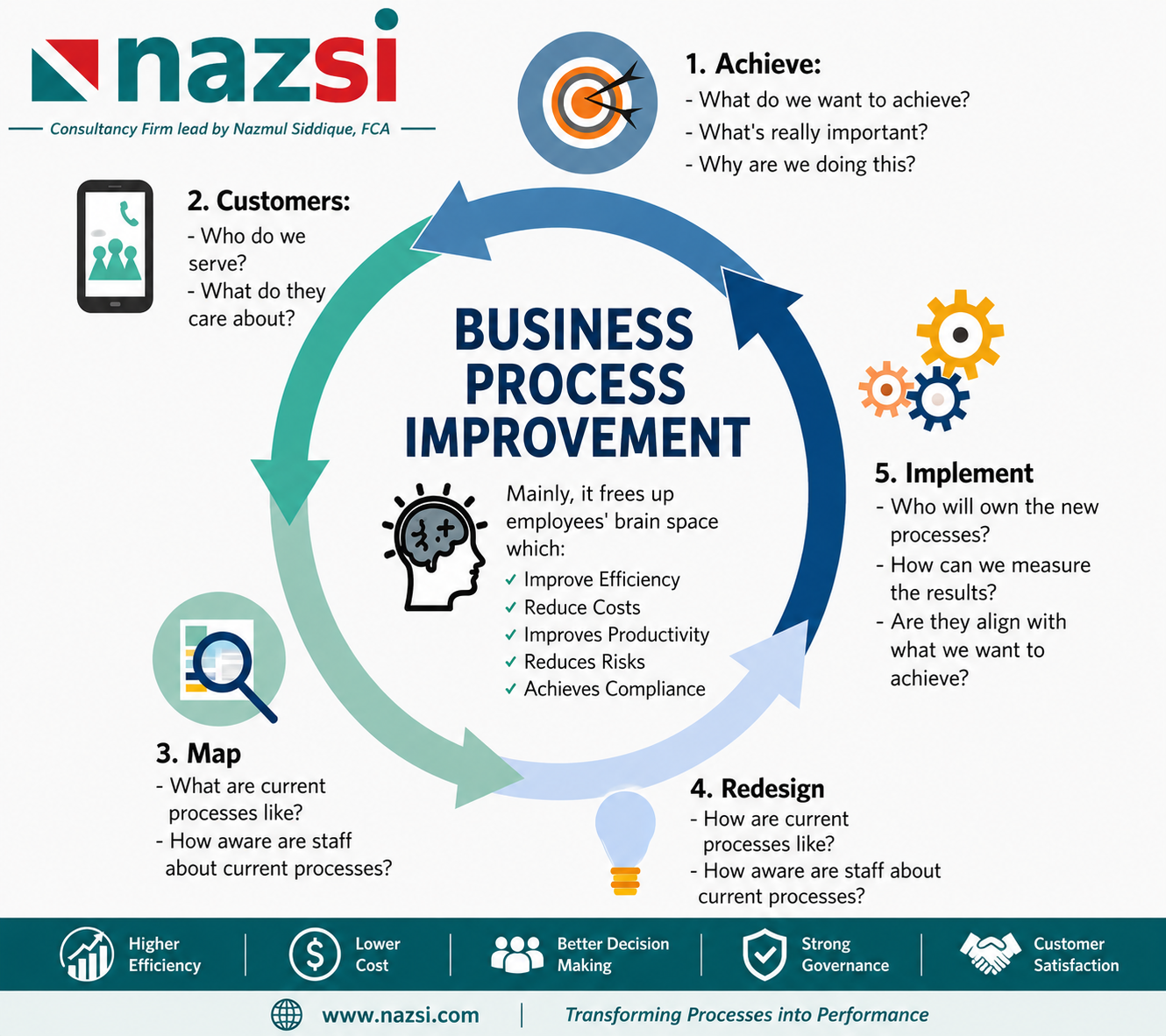
Many organizations experience strong sales and steady customer demand but still struggle with low productivity, rising costs, delayed decisions, and reduced profitability. Often, the underlying issue is not the market—it is inefficient business processes. This article explores the importance of Business Process Improvement (BPI) and discusses common organizational challenges such as silo operations, lack of KPI monitoring, manual systems, and resistance to change. It also explains practical solutions including process mapping, KPI frameworks, ERP implementation, Industrial Engineering practices, and continuous improvement methodologies. Furthermore, the article highlights the strategic role of the CFO and Accounting Information Systems (AIS) in transforming operational data into financial insights for better decision-making. The discussion emphasizes how integrating processes, technology, and financial governance can improve efficiency, strengthen control, reduce costs, and support sustainable business growth.
In today’s competitive business
environment, many organizations experience a paradox: strong market demand and
steady customer orders, yet suboptimal profitability and operational
inefficiency. The underlying issue is rarely a lack of effort or resources;
rather, it stems from the absence of structured, integrated, and continuously
improved business processes.
Business Process Improvement
(BPI) is therefore not merely an operational initiative—it is a strategic
discipline that connects daily activities with long-term organizational
success. When processes are inefficient, strategy fails in execution; when processes
are optimized, performance improves naturally.
Challenges
Organizations Commonly Face
Organizations, particularly in manufacturing and service
sectors, face several systemic challenges that hinder performance.
One of the most critical issues
is process fragmentation, where departments operate in silos. Procurement,
production, sales, and finance often function independently, resulting in
delays, duplication of work, and misaligned priorities. This lack of integration
disrupts workflow continuity and reduces overall efficiency.
Another major challenge is the
absence of structured performance measurement systems. Without clearly defined
Key Performance Indicators (KPIs), management relies on assumptions instead of
factual insights. Consequently, inefficiencies such as machine downtime,
material wastage, or idle capacity remain undetected or are addressed too late.
Organizations also suffer from
manual and disconnected systems. Heavy reliance on spreadsheets or
non-integrated software creates data inconsistency and delays in reporting. As
a result, decision-making becomes reactive rather than proactive.
Additionally, resistance to
change acts as a behavioral barrier. Employees and middle management often
prefer familiar practices, even if inefficient, making it difficult to
implement process improvements without strong leadership and communication.
Why
Business Process Improvement is Critically Important
Business Process Improvement
serves as the foundation for aligning operational activities with strategic
objectives.
Firstly, it enhances operational
efficiency by eliminating non-value-adding activities. This reduces production
costs, improves cycle times, and increases resource utilization—directly
impacting profitability.
Secondly, BPI enables visibility
and control over operations. When processes are structured and measurable,
management gains real-time insights into performance, allowing early
identification of bottlenecks and risks.
Thirdly, it strengthens corporate
governance and internal control. Clearly defined workflows and standardized
procedures reduce the risk of errors, fraud, and compliance
failures—particularly important in regulated environments.
Finally, improved processes lead
to enhanced customer satisfaction. Efficient order fulfillment, consistent
quality, and timely delivery build customer trust and long-term loyalty.
How to
Solve Business Process Inefficiencies
Effective Business Process
Improvement requires a systematic and disciplined approach.
The journey begins with process
mapping and diagnostic analysis, where organizations document existing
workflows across all functional areas. This helps identify redundancies,
bottlenecks, and gaps in coordination.
Once processes are understood,
organizations must establish structured KPIs and performance frameworks. These
metrics should link operational activities with financial outcomes, ensuring
that improvements are measurable and aligned with business objectives.
A critical enabler of BPI is
system integration through ERP platforms. An integrated Enterprise Resource
Planning system eliminates data silos, ensures consistency, and enables
real-time reporting through MIS and EIS frameworks.
In manufacturing environments,
Industrial Engineering (IE) techniques such as time and motion studies,
workflow optimization, and capacity planning play a vital role in improving
productivity and reducing waste.
Organizations should also adopt
continuous improvement methodologies such as Lean Management and Six Sigma.
These approaches ensure that improvements are systematic, data-driven, and
sustainable.
Equally important is change
management. Leadership must actively drive transformation, while employees
should be trained and engaged to embrace new processes and systems.
The Role
of CFO and Accounting Information System in Process Improvement
Business Process Improvement
cannot be sustained without strong financial governance and reliable
information systems. This is where the Chief Financial Officer (CFO) and the
Accounting Information System (AIS) play a central role.
The CFO acts as a strategic
integrator, ensuring that operational improvements translate into financial
value. By linking process performance with budgeting, cost control, and
profitability analysis, the CFO provides a financial lens through which inefficiencies
can be identified and corrected. This ensures that process improvements are not
isolated operational changes but are aligned with overall business objectives
such as margin enhancement and working capital optimization.
The Accounting Information System
serves as the data backbone of this transformation. An integrated AIS within an
ERP environment captures transactions across procurement, production,
inventory, and sales in a structured and standardized manner. This enables
accurate product costing, real-time expense monitoring, and automated financial
controls, reducing dependency on manual processes.
Furthermore, AIS-driven data
supports advanced performance analytics through MIS, EIS, and BI dashboards.
These tools provide management with actionable insights into KPIs such as cost
per unit, process efficiency, and budget variance. As a result, organizations
move from reactive decision-making to proactive performance management.
In essence, the CFO, supported by
a robust AIS, ensures that Business Process Improvement is financially
measurable, controlled, and sustainable.
Moving
Toward a Process-Driven Organization
Business Process Improvement is
not a one-time initiative but a continuous journey. Organizations that embed
process thinking into their culture are better equipped to adapt to market
changes and scale efficiently.
Leadership must shift focus from
managing results to managing processes. When processes are efficient, results
naturally improve. By integrating strategy, operations, technology, and
financial oversight, organizations can transform inefficiencies into opportunities
for growth.
Ultimately, Business Process
Improvement forms the foundation of sustainable success—enabling organizations
to achieve operational excellence, financial discipline, and long-term
competitiveness.
Md.
Nazmul Hussain Siddique, FCA
E-mail: nhs14808@gmail.com