
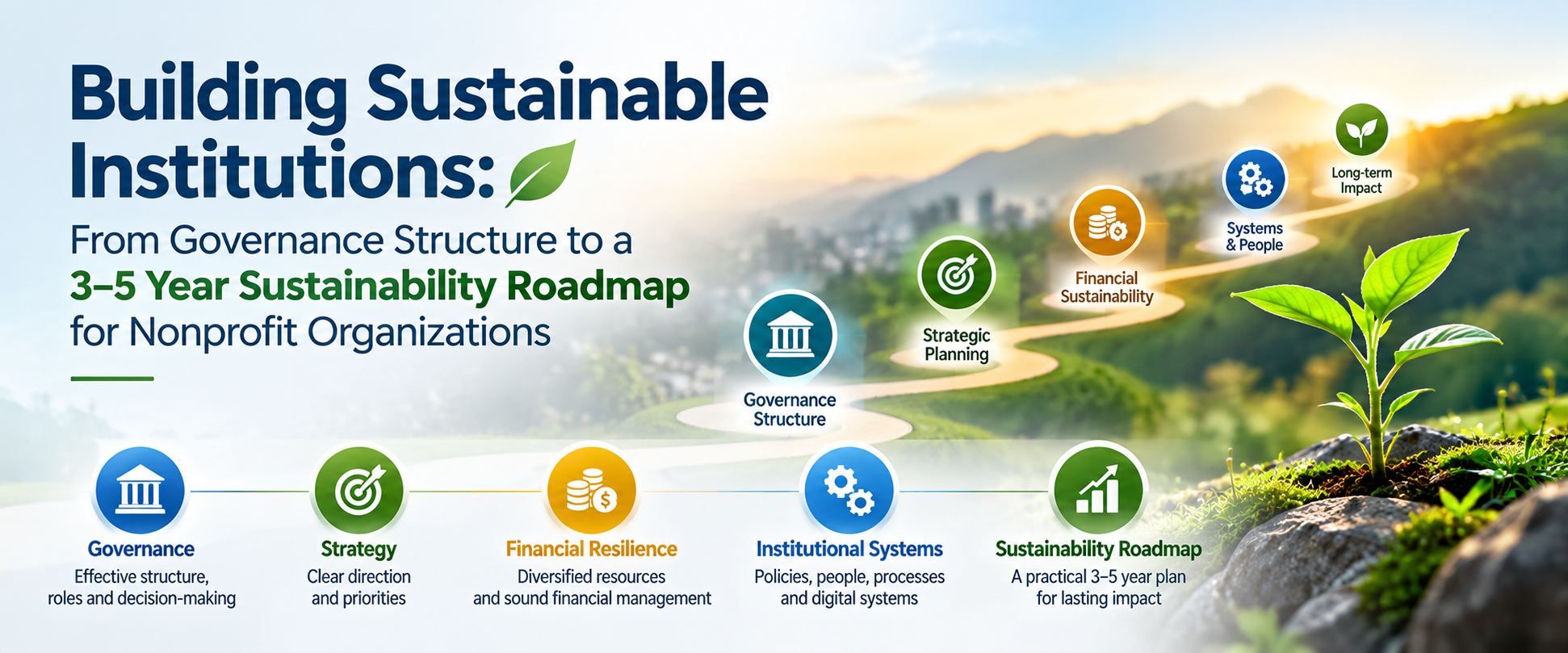
This article explores how nonprofit and mission-driven organizations can build long-term sustainability through strong governance, strategic planning, financial resilience, institutional systems and performance accountability. It presents a practical framework for translating mission into measurable priorities and a 3–5 year sustainability roadmap. The article emphasizes that sustainability is not merely about fundraising—it is about developing the institutional capacity to govern, perform, learn, adapt and sustain impact.
Building Sustainable Institutions: From Governance
Structure to a 3–5 Year Sustainability Roadmap for Nonprofit Organizations
By Md. Nazmul Hussain Siddique FCA
Strategic Management, Governance & Financial Sustainability Consultant
An institution does not become
sustainable simply because it has a strong mission, committed people, or access
to funding. Long-term sustainability requires an institutional system
that connects governance, strategy, accountability, financial resilience,
people, processes and performance.
For nonprofit organizations,
professional networks, development organizations and other mission-driven
institutions, sustainability should therefore be treated as a governance and
management objective, not merely a fundraising objective.
Governance Is the Foundation
A sustainable institution begins
with clarity about who provides direction, who makes decisions, who executes
them and who remains accountable for results.
An effective governance
architecture should clearly distinguish the roles of the governing body,
executive management, committees, secretariat and operational teams. Delegation
of authority, reporting relationships, approval limits, conflict-of-interest arrangements
and oversight mechanisms should be documented rather than dependent on
individual practices.
Good governance can be summarized through a simple
accountability chain:

When any link in this chain is weak, institutional
sustainability becomes vulnerable.
Move from Mission to Strategic Priorities
A mission explains why an
organization exists. A strategy determines what it will prioritize and
how it will use limited resources to achieve its mission.
For a 3–5 year period, an
institution should identify a manageable number of strategic priorities.
Depending on its mandate, these may include program impact, organizational
development, financial sustainability, partnerships, digital transformation,
people development, governance strengthening or geographic expansion.
Each priority should then be translated into measurable
objectives:

This converts strategy from a document into a management
system.
Financial Sustainability Must Go Beyond Fundraising
Financial sustainability is often
misunderstood as the ability to secure the next grant. A truly sustainable
institution should understand its cost structure, funding concentration,
cash-flow requirements, reserves, unrestricted funding needs and future
financial commitments.
A practical sustainability
strategy should therefore consider diversification of funding sources,
strategic partnerships, donor and partner mapping, cost recovery, responsible
earned-income opportunities where appropriate, reserve development and multi-year
financial planning.
Financial sustainability must
also be supported by strong budgeting, accounting policies, internal
controls, procurement, asset management and transparent financial reporting.
Funding without financial governance may increase institutional risk rather
than reduce it.
Translate Strategy into a 3–5 Year Roadmap
A strategy establishes direction; a roadmap establishes the
sequence for getting there.
A practical roadmap can be organized into three horizons:

Every major initiative should
identify an owner, timeline, resource requirement, expected output, KPI and
review mechanism.
This is important because
sustainability strategies often fail not because the strategic direction is
wrong, but because responsibility and implementation sequencing are unclear.
Measure Institutional Health, Not Only Activities
Organizations commonly measure
activities—number of events, participants, projects or publications. These are
useful, but they do not fully demonstrate institutional sustainability.
A balanced sustainability
dashboard should monitor indicators across several dimensions, such as:

The purpose of KPIs is not simply
to generate reports. Their real value is to enable early corrective action
and evidence-based decision-making.
Make Review Part of the Governance Cycle
A 3–5 year roadmap should never become a static document.
Management should periodically
review operational KPIs and implementation progress, while the governing body
should conduct structured strategic reviews. An annual strategy review should
assess changes in the operating environment, funding outlook, institutional
risks and performance against strategic targets.
The cycle should therefore remain continuous:

This creates an institution
capable not only of following a strategy, but also of adapting when
circumstances change.
Sustainability Is Institutional Capacity
The strongest institutions are
not necessarily those with the largest budgets. They are those capable of making
sound decisions, mobilizing resources, managing them responsibly, measuring
results, learning from evidence and adapting without losing sight of their
mission.
A meaningful 3–5 year sustainability roadmap should
therefore integrate five elements:

When these elements operate
together, sustainability becomes more than a funding aspiration. It becomes an institutional
capability.
Md. Nazmul Hussain Siddique
FCA